
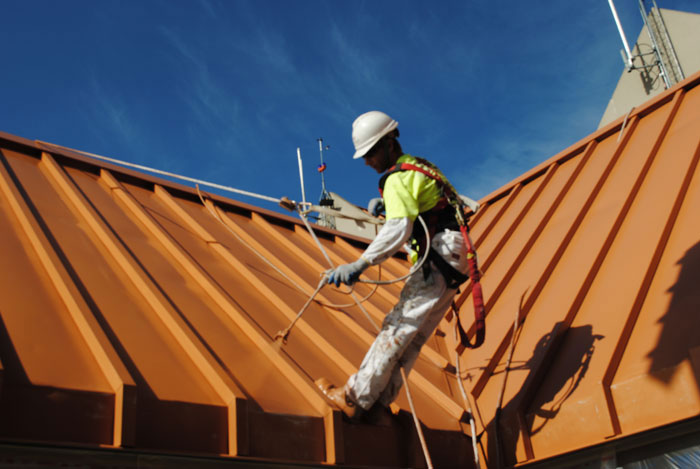
Fluoropolymer coating cost should be evaluated over the full life of a structure—not simply by the initial price of the material. Architects, engineers and asset owners also need to consider how long the coating will perform, how frequently the structure must be repainted and what each maintenance cycle will cost.
Although high-performance fluoropolymer coatings may cost more initially than conventional topcoats, their longer service life can substantially reduce maintenance, labor, staging and operational expenses over several decades. A project-specific life-cycle cost analysis can help determine whether the higher initial investment may result in a lower total cost of ownership.
What Is the Life-Cycle Cost of a Coating?
The life-cycle cost of a protective coating includes all expenses incurred during the coating system’s service life, not merely the price of the topcoat. A meaningful fluoropolymer coating cost analysis should include:
- Coating materials
- Surface preparation
- Labor and application
- Scaffolding, lifts and other access equipment
- Containment and environmental controls
- Inspections and routine maintenance
- Removal and disposal of deteriorated coatings
- Lost revenue or productivity during closures
- Future recoating cycles
Material cost is often only a relatively small portion of the total installed cost. On many buildings, bridges, water tanks and industrial structures, labor, surface preparation access, and containment can represent a meaningful share of the installed and maintenance cost. Every additional repainting cycle repeats many of those expenses.
This is why comparing coatings solely by price per gallon, price per pail or initial installed cost can be misleading. The more useful calculation is the total applied cost divided by the number of years the coating remains in service.
How Service Life Affects Fluoropolymer Coating Cost
A conventional coating may carry a lower initial price but require multiple recoats during the expected life of the structure. Each recoating project can require cleaning, surface preparation, staging, labor and new coating materials.
It may also require sections of a building, bridge or industrial facility to be closed or taken out of service. These disruptions can create costs that do not appear on the coating contractor’s invoice, including:
- Traffic detours and bridge lane closures
- Restricted access to commercial buildings
- Water tank downtime
- Interrupted manufacturing or processing
- Coordination with tenants, customers and the public
- Additional safety and environmental controls
Extending the coating service life allows owners to postpone or eliminate some of these costly maintenance cycles. Over 30 to 60 years, avoiding even one complete repaint can significantly change the economics of a project.
How FEVE-based Coatings Extend Maintenance Cycles
LUMIFLON® resins use fluoroethylene vinyl ether, or FEVE, chemistry to give protective coatings exceptional resistance to weathering. Their performance is rooted in the strength of the carbon-fluorine bonds within the polymer.
These bonds help FEVE coatings resist degradation caused by ultraviolet radiation. As a result, properly formulated coatings can retain their color, gloss and protective properties much longer than conventional topcoats.
LUMIFLON-based coatings also protect substrates from conditions that can accelerate coating deterioration, including:
- Sunlight and ultraviolet exposure
- Rain and moisture
- Chloride ions and salt
- Oxygen and oxidation
- Airborne pollutants
- Chemicals and corrosive environments
- Extreme temperatures and weather
The result is a durable finish that protects steel, aluminum, fiberglass, concrete and other substrates while maintaining the intended appearance of the structure.
Depending on the coating system, application, exposure, and maintenance conditions, certain LUMIFLON-based topcoats have been projected to provide approximately 30 to 60 years of service before major recoating. A conventional polyurethane coating system may require more frequent maintenance or recoating than a properly selected FEVE-based system under comparable exposure conditions.
Life Cycle Cost Analysis: FEVE-based Fluoropolymer Coatings vs. Conventional Coatings
An analysis based on coating specifications for steel bridges compared alkyd, polyurethane and LUMIFLON-based fluorourethane systems. The comparison included the entire coating system—not just the topcoat—and accounted for surface preparation, primers, intermediate coats, application labor and staging.
The initial applied cost of the LUMIFLON-based system was approximately:
- 35% higher than the alkyd system
- 10% higher than the polyurethane system
Once expected coating life was included, however, the financial picture changed considerably. Assuming a 30-year service life, the calculated annual life-cycle cost of the LUMIFLON-based system was approximately:
- One-third the cost of the alkyd system
- Two-thirds the cost of the polyurethane system
If the FEVE topcoat remains in service for 60 years, its relative annual cost decreases further. The analysis illustrates why the price of the resin or topcoat alone does not accurately represent the long-term value of a protective coating system.
Results from additional LUMIFLON projects indicate that the total life-cycle cost of an FEVE coating system can be approximately 40% to 80% of the cost of a polyurethane system, depending on the application and service-life assumptions.
The amount of any reduction varies by structure, coating specification, exposure, labor rates, access requirements, maintenance schedule, and financial assumptions. However, the economic principle remains consistent: the fewer times a structure must be repainted, the lower its long-term maintenance burden is likely to be.
The Costs Avoided When Recoating Is Delayed
The long-term value of FEVE-based coatings becomes clearer when the full cost of repainting is included in the analysis.
Reduced material and labor costs
A longer-lasting topcoat requires fewer replacement coatings and fewer labor hours over the life of the asset. Owners also avoid repeatedly paying for primers, intermediate coats and related materials when a complete coating replacement is required.
Lower staging and access costs
Repainting a bridge, water tower or multistory building may require scaffolding, lifts, containment systems or specialized crews. These costs can be substantial and recur with every maintenance cycle.
Less operational disruption
Coating work can interfere with traffic, building access, water service or industrial operations. Extending the interval between recoats reduces the frequency of closures and their associated economic impact.
Fewer environmental impacts
Every repainting project consumes raw materials and energy while generating removed coating material, packaging and other waste. Equipment used for access, preparation and application can also produce greenhouse gas emissions. Reducing the frequency of these activities may lower certain resource and energy demands, although the overall environmental effect should be supported by a documented assessment.
Better preservation of the substrate
A high-performance protective coating helps shield the underlying substrate from moisture, chemicals, sunlight and corrosive conditions. Maintaining the integrity of the coating system can reduce the risk of more extensive substrate repairs or premature replacement. Continued protection depends on the integrity of the complete system and the timely repair of damage or defects.
Projects that Demonstrate the Value of Long-Term Protection
Modern architectural projects illustrate why coating durability is considered during the specification process.
The Spiral in New York City
The Spiral’s aluminum curtain walls, window frames and door frames are finished with TIGER Drylac® Series 75 powder coatings formulated with LUMIFLON FEVE resins. The coating was selected to provide long-term weather resistance, corrosion protection and color stability while preserving the building’s distinctive silver appearance.
For a prominent Manhattan tower with an intricate façade, extending the period before major coating maintenance can help reduce future access requirements and disruption.
Lyrik Back Bay in Boston
Completed in 2024, the $700 million Lyrik Back Bay development spans eight lanes of the Massachusetts Turnpike and two MBTA rail lines. Its location and complex construction make future façade access and maintenance especially consequential.
The exterior façades of the office tower and hotel use a two-coat PPG CORAFLON® powder system consisting of a base coat followed by an FEVE-based topcoat containing LUMIFLON resins. The system provides resistance to UV radiation, moisture, pollutants, corrosion, scratching and fading while helping extend maintenance schedules.
These projects are relatively new and have not yet accumulated decades of field-performance data. However, they demonstrate how architects and owners apply established FEVE technology to contemporary buildings where durability, appearance and difficult maintenance access influence coating selection.
Why Initial Fluoropolymer Coating Cost Should Not Drive Selection
Selecting a coating based primarily on purchase price can create a false economy. A conventional system may appear less expensive during construction, but its shorter maintenance interval can generate considerably greater expenses over the life of the asset. Fluoropolymer coating cost should therefore be compared with the cumulative cost of every expected maintenance and recoating cycle.
A proper life cycle cost analysis should compare coating systems over the same evaluation period—often 30, 40, 50 or 60 years. The analysis should account for inflation or discount rates, expected service life and every anticipated maintenance event.
The following questions can help specifiers make a more complete comparison:
- How many times will each coating system need to be repainted?
- What surface preparation will be required during each cycle?
- How much will labor and access equipment cost?
- Will repainting interrupt traffic, building access or operations?
- What containment, disposal and environmental requirements will apply?
- How could coating failure affect the substrate?
- How long must the coating retain its color and gloss?
- What field-performance data supports the estimated service life?
Answering these questions shifts the decision from “Which coating costs less today?” to “Which coating provides the best value throughout the life of the structure?”
FEVE Coatings Provide Long-Term Value
FEVE coatings formulated with LUMIFLON FEVE resins combine weatherability, corrosion resistance and long-term color and gloss retention. These properties can extend coating service life and reduce the frequency of maintenance and recoating.
Although an FEVE system may require a moderately higher initial investment than a conventional polyurethane topcoat, that difference can be small compared with the recurring cost of labor, surface preparation, staging and operational interruptions.
For architects, engineers and asset owners, coating selection is therefore a long-term financial decision. Evaluating total cost of ownership—not simply the price per gallon—can identify a coating system that protects both the structure and the project’s bottom line for decades.
Contact AGC Chemicals Americas to discuss the right resin grade for your formulation.
Header photo credit: All-Tech Decorating Company
Frequently Asked Questions About Fluoropolymer Coating Cost
How do FEVE coatings reduce life-cycle costs?
Fluoropolymer coatings can remain in service longer than conventional topcoats, reducing the number of recoating cycles required over the life of a structure. This lowers cumulative spending on materials, labor, surface preparation, access equipment and operational shutdowns.
How long do FEVE coatings last?
Properly formulated and applied LUMIFLON FEVE topcoats can have an expected service life of approximately 30 to 60 years. Actual performance depends on the coating system, application quality, substrate, environment and maintenance practices.
How do fluoropolymer coating costs compare with polyurethane coating costs?
FEVE-based topcoats generally cost more initially. For example, a published analysis found that the complete applied FEVE system cost approximately 10% more than the polyurethane system. However, its longer expected service life produced a substantially lower annualized life-cycle cost. Actual fluoropolymer coating cost depends on the formulation, substrate, application method, project size and access requirements.
What should a coating life cycle cost analysis include?
The analysis should include coating materials, labor, surface preparation, staging, containment, inspection, routine maintenance, removal and disposal, future recoating cycles and the financial impact of closures or operational interruptions.
Where are fluoropolymer coatings used?
Fluoropolymer coatings are used on architectural façades, bridges, water tanks, industrial facilities and other structures requiring long-term resistance to UV radiation, weathering, chemicals and corrosion.